
TIMELINE for Case: 3246/Cv-C/2021
Humaida A Ghafoor v. Government of Maldives
Civil litigation to stop the Gulhifalhu Port Development Project, Maldives
Start 🔽 02 September 2021
23 August 26
![Civil Court hearing (23 Aug 2026) [Miveshi Maldives]](https://miveshi.com/wp-content/uploads/2026/08/Civil-Court-hearing-23-Aug-2026-Miveshi-Maldives.webp)
Final hearing of the main case at the Civil Court
• The procedure observed in the Kaafu Gulhifalhu case final hearing and Court decision contravenes the Civil Procedure Code. Additionally, the final hearing scheduled for 02 March 2026 with a long notice period was cancelled by the Civil Court at the last minute. Following that, on 19 August 2026, the Court issued notice that the final hearing was scheduled for today, 23 August 2026 at 10.30am. The hearing was conducted by video conference today, starting at approx. 11.30am and ended at approx. 12.00 noon.
• The Court’s decision in the main case was read by the presiding Civil Court Judge Uz. Faruhad Rasheed. Multiple concerns are observed in the manner in which this decision was reached. Therefore, in order to keep this update short, some key concerns about this decision are summarised below:
1 – It is observed that in reaching this decision, Judge Uz. Faruhad Rasheed had not referred to a variety of evidences and legal points included in the main action.
2 – It is observed that Judge Uz. Faruhad Rasheed had borrowed heavily and in verbatim from the Supreme Court’s decision in the interim injunction (stop order) related to this case, which was submitted to the Civil Court on 04 April 2023 and decided upon at the final appeal stage by the Supreme Court on 15 May 2024, which is disturbing. The Supreme Court’s decision in the interim injunction also constitute a series of concerning issues in its consideration of relevant laws, legal procedure and reliance on submitted evidential materials.
3 – In today’s decision, Judge Uz. Faruhad Rasheed said that the petitioner had not provided a comparative assessment of the damage to the environment caused by the project and the benefits of the project. However, this is not a requirement from the petitioner in this main action. Additionally, it is deeply concerning that in this civil case, the burden of proof relevant to important facts that fall on the defendant (State) is transferred onto the citizen petitioner in this decision. Therefore, it is very clear from this decision that the Civil Court of Maldives does not find that the State (or Government) is required to uphold its fundamental legal duty to protect and preserve the environment for the benefit of present and future generations and ensure that development projects are implemented in line with the principles of sustainability as enshrined in the Constitution and other national laws. Furthermore, although this serious petition was submitted with documentary and testimonial evidences that show irreversible damage would be caused to the environment, this decision shows such evidences were disregarded. Therefore, the decision suggests that the Civil Court cannot be an avenue to uphold the national laws made for the purpose of protecting the environment and holding the State accountable.
4 – The necessary work to appeal the decision of Civil Court Judge Uz. Faruhad Rasheed is currently under way.
5 – Case updates will continue to be provided on Miveshi.
20 Apr 2025
![20 April 2025 - CC hearing [Miveshi Maldives]](https://miveshi.com/wp-content/uploads/2025/04/20-April-2025-CC-hearing-Miveshi-Maldives-571x428-1.jpg)
Update of the 7th hearing for the main case at the Civil Court
• The summons for the 7th hearing scheduled for today, 20 April 2025 was sent by the Civil Court on 07 April 2025, and today’s scheduled hearing at 11.50am began at 12.03pm and concluded at 12.55pm.
• Today’s hearing was held to discuss the concluding statements of the case. On 03 April 2025, the Civil Court instructed by email for both parties to submit their concluding statements to the Court by 15 April 2025.
• The Claimant submitted the concluding statement with reference to the key issues raised in the case. At today’s hearing, the Claimant highlighted that from its commencement, the Respondent (State) had operated in contravention to laws in the K. Gulhifalhu project, and that during implementation, the State had not complied with any of the conditions specified in the EPA’s Decision Statement that approved the project EIA. Therefore, it is clear from the submitted evidence that the project has been causing irreversible damage to the environment in the project area, and as a direct consequence, impose negative social and economic impacts on the people living in the affected area. Moreover, the Claimant stated that the evidential material submitted in this case provides clear proof that the implementation of this project contravenes Article 22 of the Maldives Constitution and related laws and regulations to protect and preserve the environment.
• In their concluding statement, the Respondent primarily stated that the project was in compliance with the relevant laws and that the legal remedy sought by the Claimant was outside the jurisdiction of the Court.
• Unless the Court requires further clarification on any matter, the next step in this case is likely to be the concluding judgment. However, the Ghazee did not specify a date for the next hearing.
17 Mar 2025
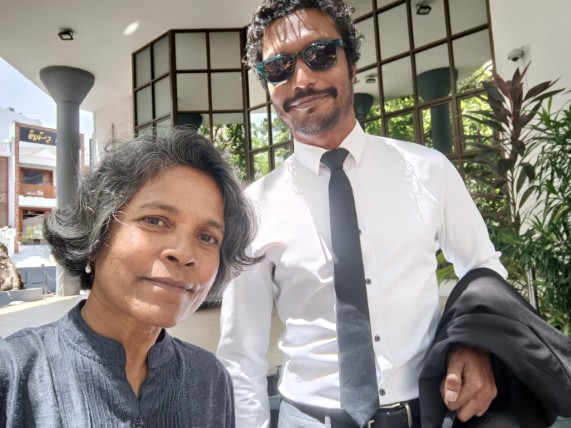
Update of the 6th hearing for the main case at the Civil Court
• The summons for the 6th hearing scheduled for today, 17 March 2025 was sent by the Civil Court on 10 March 2025, and today’s scheduled hearing at 11.50am began at 12.26pm and concluded at 13.09 (approximately 43 minutes).
• Today’s hearing was an evidence hearing where both parties were given the opportunity to discuss the submitted witness testimony. The Claimant had submitted as witnesses 2 of the most prominent and experienced divers in the Maldives, Hussain Rasheed (Sendi) and Mohamed Seeneen (Sindhi).
(Note that their testimony had to be taken twice. Details of this is given in the 19 March 2024 update provided below in this timeline).
The Respondent (State) had submitted the Director General of the Environmental Protection Agency (EPA) Ibrahim Naeem as their expert witness.
• The State advocated that the Claimant’s witnesses were “ordinary witnesses” and that their testimony cannot be recognised as “expert evidence”. However, there is no such thing as “ordinary witnesses” in law, and there is no clarification provided that distinguishes between “expert” and sector professionals of long experience. In response to this point by the State, the Claimant referred to s.13 and s.121 of the Evidence Act (11/2022) which provides there is no legal barrier to recognising such expert testimony. The Claimant further requested the Court to recognise Sendi and Sindhi’s testimony as primary evidence.
• The Claimant clarified to the court that the witnesses who provided their first-hand experience and eye-witness testimony of the negative impacts of reclamation on the reef ecosystem, including marine protected areas, gave information that aligned with the scientific documentary evidence submitted to the Court about the same. Notably, the State had sought to nullify this witness testimony by resorting to a semantic debate instead of relying on legal provisions. At today’s hearing, the Claimant raised a complaint to the Court about the disrespect directed towards her expert witnesses by the State at the testimony hearing, in an attempt to nullify the validity of their testimony.
• The issue was raised by the Claimant at the 19 March 2024 witness testimony hearing also, that the State’s single witness, Director General of the EPA Ibrahim Naeem is not legally allowed to give testimony in this case. This is because in addition to Ibrahim Naeem being the head of the EPA which is one of the three Respondents in this case, he is also the signatory who approved the Decision Statement permitting the K. Gulhifalhu reclamation project and its Environmental Impact Assessment (EIA) of April 2020. This conflicts with s.51 of the Evidence Act (11/2022).
(Details of this is provided below in the 19 March 2024 update in this timeline).
In addition, at today’s hearing s.122(b)(3) and (6) were cited in support of this point of law.
• At today’s hearing, both parties were allowed one opportunity to discuss witness testimony. One reason for this is because the presiding Qazi wanted to shorten the hearing due to it being Ramadan. With reference to the witness testimony discussion today, the Qazi did not make a decision whether to accept or dismiss any of the witness testimony.
• The next hearing would be held to present concluding statements of the case. Presiding Qazi Uz. Farhad Rasheed announced that the next hearing of the case would be held around 20 April 2025. This is because the long public holiday break for the last 10 days of Ramadan is imminent, after which, the Eid holidays will follow. Qazi Uz. Farhad observed that due to the heavy documentary content of the case, both parties would need ample time to prepare. The State Attorney said that currently, he is the person assigned to this case and given that he recently took the case afresh, he would need time to prepare. I do not believe that this should be an issue that should arise at the Attorney General’s Office (AGO). This is because I believe that cases overseen by the State ought to be managed by teams of attorneys in an organised manner. The fact that a case of this scope is being assigned afresh to one person indicates the existence of management gaps that need improving at the AGO.
24 Feb 2025
![Court hearing Miveshi Maldives [24 Feb 2025]](https://miveshi.com/wp-content/uploads/2025/02/Court-hearing-Miveshi-Maldives-24-Feb-2025.jpg)
Update of the 5th hearing for the main case at the Civil Court, following the 19 March 2024 witness testimony hearing
• In the main case to stop the port development project at K. Gulhifalhu, witness testimony was first taken at the Civil Court at a hearing held on 14 March 2023, at the 4th case hearing. However, due to a technical issue at the Civil Court, the hearing recording file was corrupted, leading to a repeat hearing held on 19 March 2024 (one year later). Following this, the administrative processing of the witness testimonies (transcription etc) were completed in October 2024.
• The summons for the 5th hearing scheduled for today, 24 February 2025 was sent by the Civil Court on 16 February 2025, and today’s scheduled hearing at 11.45am began at 12.02 and concluded at 12.08 (approximately 6 minutes).
• Although today’s hearing was to discuss the witness testimonies, a summary statement of witness testimonies was shared with the court by the Claimant, and the same requested from the State.
• At today’s hearing also, Qazi Uz. Faruhad Rasheed made note of his concern about the delays in progressing the case citing resource limitations and challenges faced by the Court, recognising that the Claimant would want to expedite the case.
• At today’s hearing, it was observed that the State Attorney representing the Attorney General’s office is a completely new attorney on this case.
• As per the Claimant’s request, the Qazi instructed the State to submit a written statement on witness testimonies. The earliest possible date the State could submit this was identified as Thursday, 6 March 2025, hence the Court instructed the State to observe this submission date.
• The Qazi announced that in order to expedite the case, the hearing to discuss witness testimony would be scheduled for Sunday 9 March 2025. Following that, a date would be set to submit the final statements in this case.
11 Aug 2024
![Supreme Court [11 Aug 2024] #saveMaldives](https://miveshi.com/wp-content/uploads/2024/08/Supreme-Court-11-Aug-2024-saveMaldives-571.jpg)
Request to review the Supreme Court’s decision of 15 May 2024 on the temporary stop order
• The High Court’s decision in judgment number 2023/HC-A/267 of 14 February 2024 regarding the application for a stop order (interim injunction) to halt the K. Atoll Gulhifalhu reclamation project was appealed by the State at the Supreme Court on 15 February 2024.
• In its decision of 15 May 2024, the Supreme Court ruled to nullify the High Court’s decision to grant a stop order. A series of concerns about this decision was published previously on Miveshi on 16 May 2024. (See brief analysis of the judgment)
• In addition to this, due to the contention that the Supreme Court’s decision had certain fundamental errors and disregard to laws and legal principles, using the Supreme Court’s procedure through the “Application form requesting to review a decision of the Supreme Court”, a request was submitted today, 11 August 2024, to review the court’s judgment number 2024/SC-A/08.
• Although a decision of the Supreme Court is final, due to the fact that fundamental errors had been made historically in the court’s decisions in certain instances, a review procedure of such decisions had been introduced in the Maldives context. The reason for using that procedure to submit a request for review is due to having serious concerns about the court’s decision in this matter.
• Although the review request is at the registration stage at this point in time, it is hoped that in light of the submitted concerns, the Supreme Court will accept this review submission.
15 May 2024
State’s Appeal of the High Court’s Decision at the Supreme Court – Update – Fifth Hearing – Decision
• Following the State’s fourth appeal hearing at the Supreme Court on 06 May 2024, the fifth hearing was scheduled for 6 May 2024 at 09.45am. The public hearing was conducted via Microsoft Teams from 10.01am to 10.29am today.
• Today’s hearing was conducted by the Supreme Court’s following 3 judge bench:
1) Judge Uz. Ali Rasheed Hussain (Chair)
2) Judge Dr. Azmiralda Zahir
3) Judge Uz. Husnu Suood
• The unanimous decision of the 3 judge Supreme Court bench was that the decision of the High Court in this appeal case was unlawful and therefore declared void by the Supreme Court.
• Judge Dr Azmiralda Zahir concurred with the opinion of Judge Uz. Ali Rasheed Hussain. Judge Uz. Husnu Suood also did so, after making note of some additional points.
• An analysis of some of the key points in the Supreme Court’s decision is separately available at this link.
• Overall, the message received from this Supreme Court decision is that the existing environmental protection laws in the Maldives do not have to be implemented or upheld by the implementing authorities to serve the purpose for which they are made. Additionally, the destructive projects carried out by foreign companies can be conducted outside the national legislative structure in ways that favour them, with the State as a protective shield to continue such projects. In this situation, the basic rights of citizens and the public interest can be set aside.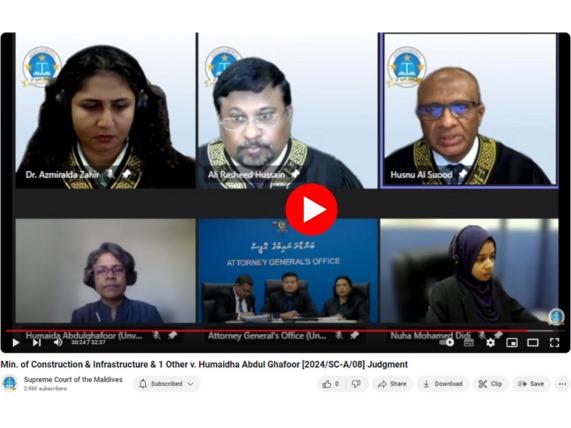
Supreme Court’s Decision PDF (Dhivehi) [15 May 2024]
Supreme Court’s Decision PDF (Unoffical English translation)
[added: 17 June 2024]
06 May 2024
State’s Appeal of the High Court’s Decision at the Supreme Court – Update – Fourth Hearing
• Following the State’s third appeal hearing at the Supreme Court on 28 April 2024, the fourth hearing was scheduled for 5 May 2024. However, this was rescheduled to today, 6 May 2024 at 09.45am. The public hearing was conducted via Microsoft Teams from 10.05am to 10.51am today.
• Today’s hearing was conducted by the Supreme Court’s following 3 judge bench:
1) Judge Uz. Ali Rasheed Hussain (Chair)
2) Judge Dr. Azmiralda Zahir
3) Judge Uz. Husnu Suood
• The State continued to complete its rebuttal statement at today’s hearing, as this was not completed at the third hearing. The Chair of the Judges’ bench observed that more time than usual had been given to hear the substantive arguments in this case and at today’s hearing, each party was given 10 minutes to provide any further comments. Time was given to both parties to answer questions from the Justices and to give brief concluding comments.
• Following are some notable points from the questions from the Judges.
1) Noting that the Appellant State had said project stoppage would cause significant financial damages, Judge Uz. Ali Rasheed Hussain asked whether documentation had been submitted on this point and to clarify the amounts involved. In response, the State said that documentation had been submitted and the damages constitute “idle charges” at Euro 6,000/- (six thousand) per hour and “standby periods” at Euro 17,700/- (seventeen thousand seven hundred) per day.
(( On this point, it is notable that at the first Supreme Court hearing of this case on 13 March 2024, the amount cited is different, which was that “idle charges” would cost the State Euro 15,300/- (fifteen thousand three hundred) per hour.))
2) In connection with the above question, Judge Uz. Husnu Suood asked whether the agreement included any exception clauses such as due to reasons of natural (disasters) or environmental damage. In response, the State said that there were no such exception clauses in the agreement.
3) The additional question posed by Judge Uz. Husnu Suood was whether the agreement was vetted by the Attorney General’s Office (AGO). The State responded saying that as a general rule, the procedure is that such agreements would be seen by the AGO. However, in this case, this did not happen and the AGO had sight of the documents in connection with this case. This information suggests that the Gulhifalhu reclamation project agreement did not follow the established administrative protocols.
4) Noting the claim by the Respondent that approximately 50 islands had been subject to land reclamation, Judge Uz. Ali Rasheed Hussain asked whether the damage caused by this had been rectified or reversed. In response, the Respondent said the available evidence suggests that such information is not available, citing the example of the dearth of post-project impact monitoring for the 2016 Feydhoo reclamation project, observed in the 2022 EIA for the Addu Atoll land reclamation project. It is not common practice to do follow up research to establish the impact of damage caused by such projects, so there is an issue of absence of such research, preventing a direct answer to the Judge’s question. A 2015 scientific paper on the impact of the 1998 mass coral bleaching event in the Maldives showed that recovery was not complete.
• Closing today’s hearing, the Chair of the Judges’ bench said that the case will be concluded at the next hearing, although a date was not set for the next hearing today.
Video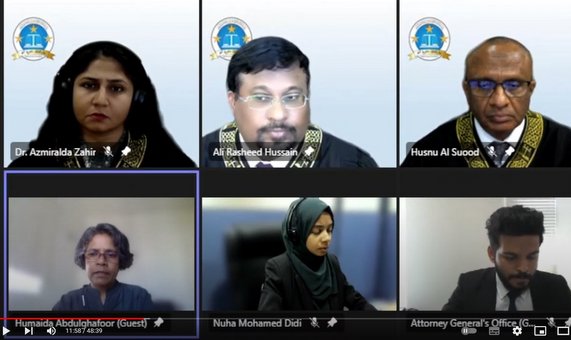
28 Apr 2024
State’s Appeal of the High Court’s Decision at the Supreme Court – Update – Third Hearing
• One month after the State’s second appeal hearing at the Supreme Court on 28 March 2024, the third hearing was scheduled for today, 28 April 2024 at 10.45am. The public hearing was conducted via Microsoft Teams from 11.03am to 12.00pm today.
• Today’s hearing was conducted by the Supreme Court’s following 3 judge bench:
1) Judge Uz. Ali Rasheed Hussain (Chair)
2) Judge Dr. Azmiralda Zahir
3) Judge Uz. Husnu Suood
• Due to time limitations, the Respondent’s response to the State’s points of appeal were not completed at the second hearing. Therefore, time was allowed to complete this at this hearing. The State was given the opportunity to respond in return, although the hearing was adjourned at 12.00pm before this response was complete.
• Some of the responses given to rebut the State’s points of appeal at this hearing are as follows.
1) At the 28 March hearing, Judge Husnu Suood asked multiple questions in relation to the long term impacts of sedimentation on corals and whether reefs can revive following such impacts. At today’s hearing, a more comprehensive response was provided to clarify these questions, using scientific research on such impacts including site-specific experiential information available from the Maldives.
2) The opportunity was given to elaborate on the State’s 4th point of appeal to which a response was given at the 28 March hearing. The cost of project monitoring was presented at that hearing, which is estimated between USD 1.7 to 1.8 million with the assertion that despite the high cost, such monitoring is weak and inadequate. It was clarified to the court at today’s hearing that this monitoring is done by a party appointed by the contractor, who are also the party that conduct the EIA in favour of the project. The significance of the issue of conflict of interest in these processes was highlighted.
3) Response was given to the State’s 5th point of appeal, one part of which claimed that the High Court’s decision had the same effect as the remedy sought by the substantive case. It was explained to the court that there is no basis for this claim, citing relevant case law. Additionally, it was presented to the court that the State’s claim about the inaccuracy of the application of the Nexbiz criteria in this case also has no basis, citing case law and legal principles used in such cases in other jurisdictions.
4) A point of note in today’s response was that an announcement was made by one of the State’s Appellants, the Ministry of Construction and Infrastructure on 16 April 2024, stating that the land reclamation for the second phase of the Gulhifalhu project had been completed. As such, it was highlighted to the court that in this case, the Maldivian State, including the Courts and other relevant authorities have all failed to uphold the country’s laws established to protect the environment.
• Closing today’s hearing at 12.00pm, the Chair of the judges bench said that as the State had not finished giving their responses, opportunity will be given at the next hearing to do so and for the Respondent to respond, as well as time to answer questions from the Judges.
• After today’s hearing, the Supreme Court has issued a summons stating that the 4th hearing of this case has been scheduled for 8.45am on Sunday 5 May 2024.
Video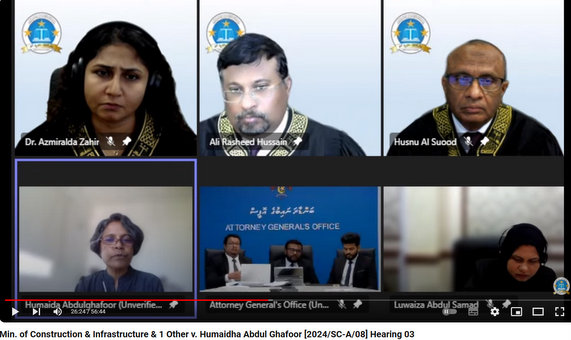
28 Mar 2024
State’s Appeal of the High Court’s Decision at the Supreme Court – Update – Second Hearing
• Following the State’s first appeal hearing at the Supreme Court on 13 March 2024, the second hearing was schedule for today, 28 March 2024 at 10.15am. The public hearing was conducted via Microsoft Teams from 10.35am to 11.30am today. Due to a technical issue, the hearing was interrupted for a moment, but resumed and completed without any further interruptions.
• Today’s hearing was conducted by the Supreme Court’s following 3 judge bench:
1) Judge Uz. Ali Rasheed Hussain (Chair)
2) Judge Dr. Azmiralda Zahir
3) Judge Uz. Husnu Suood
• At this hearing, the Respondent was given the opportunity to respond to the State’s points of appeal.
• As such, although responses to most of the points of appeal were given in the available time, a further hearing was allowed by the Court to complete the response.
• A few of the responses given to rebut the State’s points of appeal are as follows.
1) Concern about omissions and confusions in the use and referencing of evidential materials and available information in the State’s appeal.
2) That this matter relating to a temporary injunction was submitted under s. 242(b)(2) of Law No. 32/2021 (Civil Procedure Code) requesting for an emergency order, 15 March 2024 marked 1 year without the case having reached a conclusion.
3) The decision of the High Court on the matter of this temporary injunction is the most well researched, legally sound and professionally concluded decision of this type by a Maldivian court to date, involving environmental protection.
4) While the Appellant has argued that the High Court’s interpretation of the submitted case information is inaccurate, this interpretative inaccuracy is a problem not of the court but that of the Appellant.
5) That it is evident from the project EIA that the estimated cost of project monitoring was between USD1.7 – 1.8 million. However, the monitoring efforts fall below par given that a review of recently available monitoring reports show that elements such as sedimentation and others remain consistently outside the required parameters. The review report of the project monitoring reports was conducted by the Science Team at Environmental Law Alliance Worldwide (ELAW) for the Respondent.
6) The Appellant complained that in its decision, the High Court had not considered the current status of the project. In response, it was submitted that there is no notable improvement in the present condition to the previous condition based on the findings of the review of the monitoring reports, and that then and now, the effects of sedimentation is significant. When the current situation is considered, the present danger to the coral reefs are heighted due to increased global sea surface temperatures. Therefore, it was argued that what is needed when considering the current status is not just to stop the Gulhifalhu land reclamation project. It is both a moral and legal obligation for all concerned to halt all such reclamation activities inflicting reef damage in order to protect the coral reef ecosystems of the Maldives.
• The remaining responses to the points of appeal that was not completed at today’s hearing would be allowed at the next hearing, after which, the State will get the opportunity to respond to these rebuttals as noted by the Chair of the judges bench.
• The Supreme Court informed via email today that the next hearing is scheduled for 15 April 2024 at 10.15am, although this has since changed. A new hearing date is yet to be confirmed.![SC hearing 28 Mar 2024 [Miveshi Maldives]](https://miveshi.com/wp-content/uploads/2024/03/SC-hearing-screenshot-28-Mar-2024-c.png)
19 Mar 2024
![Miveshi Civil Court team [19Mar24]](https://miveshi.com/wp-content/uploads/2024/03/Miveshi-Civil-Court-team-19Mar24-571x428-1.jpeg)
Repeat of the 4th hearing of the main case held at the Civil Court on 13 March 2023 – Update
• One year ago on 13 March 2023, a hearing was held to submit witness testimony for the main (substantive) case. However, due to technical problems experienced by the court causing the recording files of that hearing to become corrupted (details of this in the 28 October 2023 update below) the court decided to repeat this hearing.
• As such, although efforts were made to schedule this hearing twice between August 2023 and now (that is, on 27 February 2024 and 7 March 2024), these hearing dates were cancelled for various reasons.
• Therefore, on 10 March 2024, the court informed via email that a hearing was scheduled for today, 19 March 2024 at 10.30am. The hearing began at 10.41 and ended at 12.25pm. At the start of the hearing, Judge Uz. Farhad Rasheed apologized for the technical issues on behalf of the court, explaining that additional measures had been taken to prevent its repetition.
• This hearing was conducted to submit witness statements for the main case. Therefore, the two expert witnesses presented by the applicant, who gave evidence at the 13 March 2023 hearing who are esteemed and expert divers with special expertise and experience of Male’ atoll, Hussain Rasheed (Sendi) and Mohamed Seeneen (Sindhi) gave evidence at today’s hearing.
• The respondent (State) presented the incumbent Director General of the Environmental Protection Agency (EPA) as their subject matter expert. The State claimed that Mr Naeem’s expert statements were not provided in his capacity as the head of the EPA, but rather solely as a subject matter expert. However, citing Law No. 11/2022 (The Evidence Act), we objected that this contravened multiple provisions of the law including s. 51 of the law which states that:
“Unless otherwise stated in a provision of this law, witness statements must not be taken from persons with a conflict of interest or in an adversarial position to any party in a case.” (unofficial translation)
However, the Judge stated that this dispute would be considered in evaluating the evidence and allowed the proceedings to continue. We accepted this with the caveat to proceed for the purpose of debate only.
• In contrast to the 13 March 2023 hearing, at today’s hearing, all persons giving witness statements were required to take an oath on the Quran. (On 13 March 2023, Mr Naeem was exempted from doing this, citing his position as an ‘expert witness’.) On that occasion, we made note of the discriminatory practice by the court in our update, and recognise this consistency towards all parties as a positive change.
• It is expected that after today’s hearing, it will take some time for the witnesses to sign their statements. No decision was taken about a date for the next hearing.
13 Mar 2024
State’s Appeal of the High Court’s Decision at the Supreme Court – Update – First Hearing
• Following the Supreme Court’s 15 February 2024 stay of execution order against the High Court’s 14 February 2024 decision, the State submitted its appeal of the High Court’s decision on the same day.
• As respondents in this case, we received the preliminary documents and the State’s appeal submissions for the case on 18 February 2024, with a deadline to submit our response by 29 February 2024.
• On 25 February 2024, we sent a request letter to the Supreme Court to extend the submission deadline to 7 March 2024 to enable the appointment of a lawyer and prepare our response. However, this request was rejected due to the urgency of the case and the court’s plan to hold the first hearing during the first week of March, as per the court’s response letter on 26 February 2024.
• As things turned out, on 7 March 2024, we received notice that the first hearing was scheduled for today, 13 March 2024.
• The hearing was scheduled for 9.15am today, 13 March 2024, and took place virtually via Microsoft Teams, from 9.45am to 10.28am.
• Today’s hearing was conducted by the Supreme Court’s following 3 judge bench:
1) Judge Uz. Ali Rasheed Hussain (Chair)
2) Judge Dr. Azmiralda Zahir
3) Judge Uz. Husnu Suood
• Today’s hearing was primarily for the Appellant (State) to submit its points of appeal and explain the details of the case to the court.
• As such, noting that the State’s explanatory points of appeal raised certain questions that required factual and evidential clarity, we made two interventions to provide clarification to the court, which were allowed.
These were:
1) Judge Uz. Husnu Suood asked the State to clarify whether the project contract included any clauses involving points of environmental protection as per the EIA.
– On this point, we provided factual information of news reports that the project contract was made in October 2019, and that the EIA commenced in December 2019 as per the EIA.
2) The State made repeated claims at this hearing that 80% of the project has been completed.
– On this point, we requested to know the evidential basis of this figure, as this conflicts with completion related numbers shared by the State at the 23 November 2023 hearing at the High Court. The court asked the State to clarify this point as well.
• As the respondent at this hearing is represented by Humaida, the Chair of the bench noted that we still have the opportunity to appoint a lawyer for the next hearing.
• The Chair of the bench said that the respondent will have the opportunity to respond to the State’s points of appeal at the next hearing. (No hearing date has been set at this time.)
13 March 2024 Supreme Court hearing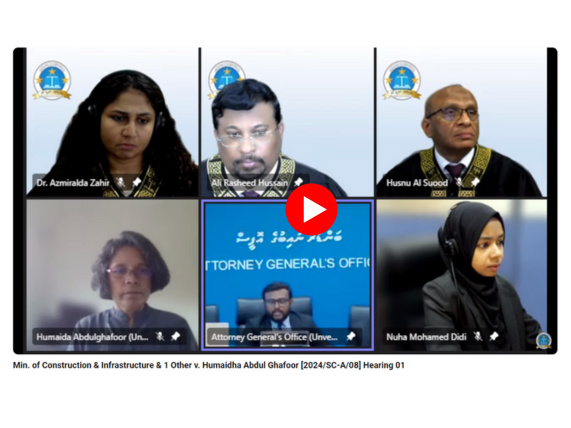
14 Feb 2024
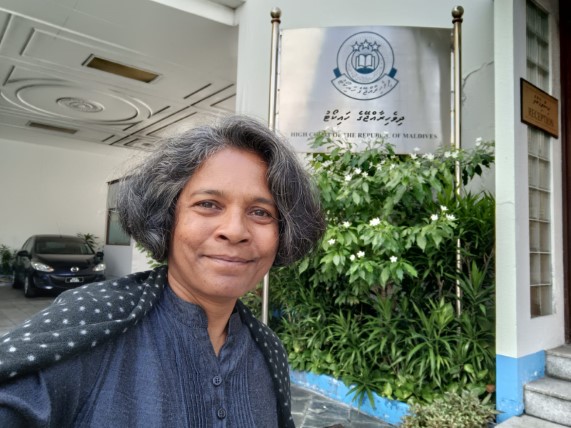
Special update: Civil Court TSO Decision Appeal at High Court – The High Court’s Decision
• The decision hearing about this case was scheduled for 9.00am at the High Court of the Maldives today, 14 February 2024, and took place between 9.25am and 10.15am. The following decision was issued by the 3 judge bench with the majority ruling by 2 judges.
1 – The decision overruled the TSO decision of the Civil Court of the Maldives of 8 June 2023 declaring that decision void.
2 – The court issued a temporary injunction or TSO for the respondent (the State) to halt the ongoing dredging and reclamation project at Gulhifalhu until the substantive case currently ongoing on this matter at the Civil Court is concluded.
3 – The 2 judges in favour of the decision are Judge Mohamed Shaneez Abdullah and Judge Huzaifa Mohamed. Judge Mohamed Niyaz issued his dissenting opinion.
We welcome the Court’s decision and plan to share further details in the coming days. The court’s decision is available below (Dhivehi original).
• However, we wish to make note of and celebrate the fact that in its decision, the court had given particular consideration to the ‘precautionary principle’ in international law by reviewing its history and providing a comprehensive review of the principle’s use and application in courts around the world. We are extremely happy and gratified that the High Court of the Maldives has taken the lead in upholding this principle for the first time in a national court, thereby setting this historic precedent.
• We also recognise that this is an important achievement in a public interest case relating to the defence of the fragile environment of the Maldives in a national court of law.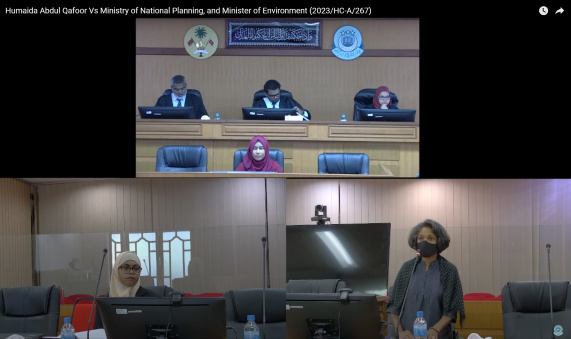
VIDEO: Humaida Abdul Qafoor Vs Ministry of National Planning, and Minister of Environment (2023/HC-A/267)
High Court’s Decision PDF (Dhivehi) [14 Feb 2024]
High Court’s Decision PDF (Unoffical English translation)
[added: 08 Apr 2024]
Extensive local news coverage (14 Feb):
• Addu Live
• Adhadhu
• Avas.mv
• CNM.mv
• Dhauru News
• Jazeera
• MBR (now deleted)
• Mihaaru
• Sun.mv * EN
• Sun.mv DHI
• Raajje.mv
• Thiladhun
23 Nov 2023
Civil Court TSO Decision Appeal at High Court – Update – 3rd hearing
• Following two cancellations of the scheduled hearings for 7th November and 16th November 2023, the hearing scheduled for today, 23 November 2023 at 11.00am took place at the High Court.
• Today’s hearing began at 11.20am and concluded at 12.25pm. The hearing was presided by the same bench of three judges as the first appeal hearing.
• Overall, today’s hearing involved responding to the questions from the bench by both parties. Time was given to answer questions from the bench to both parties about various points of law, arguments and evidential documentation provided about the appealed case.
• Due to the resignation of the lead Senior State Attorney in this case to date, Uz. Hammad Wafir, the new lead State Attorney at today’s hearing was Uz. Ahmed Mohamed who had been supporting Uz. Wafir in this case. State Counsel Uz. Ahmed Nashath attended as an additional state representative.
• Concluding today’s hearing, Judge Uz Mohamed Shaneez Abdullah said that this is the final discussion hearing in this case, and the court’s decision would be announced at the next hearing. A date for the decision hearing is yet to be clarified.

16 November 2023 – Civil Court TSO Decision Appeal at High Court – Update – 3rd hearing cancelled for the 2nd time
• The second hearing of this appeal case at the High Court was held on 05 November 2023
• On the same day, we received a High Court summons for a third hearing scheduled for 7 November 2023 at 11.00am.
• However, on the morning of 7 November 2023, we received notice by phone from the High Court that the hearing was cancelled. The reason for this cancellation was because the State Attorney Uz. Hammad Wafir had to attend another hearing at the Supreme Court.
• On the same day, we received a High Court summons that the third hearing was now rescheduled to 16 November 2023 at 9.00am.
• However, today, 16 November 2023 in the morning shortly after 8.30am, we received notice by phone from the High Court that the hearing was cancelled again. We arrived at the court and failing a request to directly meet with the relevant section handling the case, we were able to use the court’s reception phone to share our concerns with a legal officer at the court, about the last minute cancellations of scheduled hearings.
• We learned from the court that the reason for the cancellation of today’s hearing is due to the resignation of the State Attorney Uz. Hammad Wafir from his position as Senior State Attorney at the Attorney General’s Office.
• In this case, it is with regret that we observe that it is commonplace for hearings that are schedule following long delays to get cancelled at the last-minute due to the way the State Attorney manages workflow. On some occasions, the cancellation notice had been received after we arrive at the court for the hearing. We have previously sent a letter of concern to the Attorney General due to the last-minute cancellations of hearing in this case due to the unavailability of the State Attorney (please refer to the 27 February 2023 update). We believe this issue is recurring due to continuing challenges of workflow management at the Attorney General’s Office.

05 November 2023 – Civil Court TSO Decision Appeal at High Court – Update (Second Hearing)
• The first appeal hearing was held at the High Court on 30 October 2023, and we received a summons on 01 November 2023 for a second hearing scheduled for today, 05 November 2023.
• Today’s hearing began at 9.25am and ended at 10.30am, and was presided by the same 3 judge bench as the first hearing.
• Overall, today’s hearing continued by giving time to both parties to clarify questions from the bench.
• Given the complexity (and confusions) of the case, the clarifications sought by the bench were not completed within the scheduled time, and the court decided to hold a third hearing.
• It was evident from the questions put forward by the judges at today’s hearing that there is an interest from the bench to understand the environmental impacts of the case and the arguments from both sides. To date, there has been no opportunity to bring an environmental protection case to a Maldivian court by a citizen in the public interest. We believe that this level of curiosity is a necessary characteristic by a judge in such a case, which is encouraging.

30 October 2023 – Civil Court TSO Decision Appeal at High Court – Update (First Hearing)
• The Civil Court’s decision rejecting the TSO was appealed at the High Court on 18 June 2023 (please refer to updates below from 13 July 2023 – 14 September 2023)
• However, a second hearing was scheduled for today, 30 October 2023 at 9.00am and held at the High Court
• Today’s hearing began at 9.25am and ended at 10.20am. The hearing was presided by a 3 judge bench. The bench included :
1 – Judge Uz. Mohamed Shaneez Abdulla (Chair)
2 – Judge Uza. Huzaifa Mohamed
3 – Judge Uz. Mohamed Niyaz
• At this hearing, both parties (the appellant and the respondent) provided an introduction to the respective points of the appealed case and offered clarifications to the bench
• Due to the end of the scheduled time, today’s hearing was adjourned at 10.20am, with the Chair of the bench stating that due to the nature of the case, a further hearing would be scheduled as soon as possible.
• The fact that today’s hearing was successfully held at the High Court is a source of relief in the context of this case.
Civil Court TSO Decision Appeal Hearing at the High Court
28 October 2023 – Fourth Civil Court Hearing To Be Repeated
Update on the case submitted to the Civil Court of Maldives on September 2021, to stop the reclamation project at Kaafu Atoll Gulhifalhu
• The case has been stagnating at the Civil Court for 2 years now
• The last evidence hearing of the case was held in March 2023. At that hearing, Qazi Uz. Faruhad Rasheed said that due to the limited resources of the court, it will take time to transcribe the witness statements and he understood the concerns about the delays.
• In March we sought a Temporary Stay Order (TSO) against the project, and on 10 June 2023, the Civil Court decided not to issue a TSO. The decision was made by Qazi Uz. Faruhad Rasheed. (see below update of 11 June 2023)
• During August and September, we made repeated inquiries at the court to clarify the status of progress on the witness statements and their completion. In September, court officials informed that arrangements will soon be made for witnesses to sign their statements.
• However, due to the continuing delays and the fact that 6 (six) months had elapsed in this process, we sent a formal letter of concern to the court on 6 September 2023. To date, the Civil Court has not provided a direct response to this letter.
• However, on 19 October 2023, the Civil Court issued as order, which said :
“Due to the fact that the 13 March 2023 witness statement recording files have been corrupted and efforts to retrieve these have been unsuccessful, it has not been able to transcribe the recorded statements to date.”
Therefore, the order stated for us to provide a new date on which we can present witnesses to the court for a repeat hearing.
• Although we proposed a new hearing date of Wednesday 25 October 2023, the court was not able to arrange the hearing on this date.
• In addition, it came to our attention that the official court schedule for Wednesday 25 October 2023 had included our case on its schedule for the day, although we had not received a summons from the court. When we inquired about this, the court informed this was a mistake. Therefore, on the same day, 25 October 2023, we sent a formal letter to the court requesting that this mistake is amended on the days’ schedule.
• Although there is some indication from the court that a repeat witness hearing would be scheduled in November 2023, this will only be clear once the Civil Court provides this information in writing.
• It is our intention to submit our deep concerns about the procedural weaknesses experienced at the courts in this case to the oversight authorities of the courts and judicial system in the Maldives.
14 September 2023 – Civil Court TSO Decision Appeal at High Court – Update
• This update in connection with the update of 24 August 2023 is to record additional concerns in relation to the ongoing case.
• On 7 September 2023, we received email communication from the High Court that a hearing was scheduled for this case at 10.00am on 14 September 2023 (today).
• However, we received a phone call from the High Court on 13 September 2023 to the effect that the hearing scheduled for today (14 September 2023) has been cancelled.
• Following efforts to find out the reason for this cancellation from the court, we understand this is due to the presiding judge in the case taking leave.
• It is a serious concern of the applicant that this case has continued to experience delays despite the fact it is an appeal case relating to a TSO. Therefore, today (14 September 2023) we have sent a letter to the High Court raising concerns about the delay and requesting to expedite the case.

24 August 2023 – Civil Court TSO Decision Appeal at High Court – Update
• Following the request for a TSO regarding the Kaafu Atoll Gulhifalhu reclamation project at the Civil Court of Maldives which was rejected on 11 June 2023, the court’s decision was appealed at the High Court on 18 June 2023. The High Court instructed a series of administrative amendments to the appeal submission documentation.
• Therefore, on 12 July 2023, the documents were submitted with revisions and accepted by the Registrar at the High Court on 20 August 2023.
• To date, case documents have been submitted to the Civil Court via electronic communication (e-copies using email communication). However, at the High Court, once the registrar accepted the electronically submitted documents, instructions were given to provide printed copies of documents by 23 August 2023, which were submitted.
• The High Court appeal submission includes several reference sources and as such, the 3 sets of printed copies required by the High Court would have amounted to upwards of 10,600 pages (21 reams of A4 size paper). Therefore, after discussions with the Court, this amount was reduced to approximately 3,000 pages (6 reams of A4 size paper).
• Notably, Kaafu Atoll Gulhifalhu reclamation case was submitted to the Civil Court in 2021, and the TSO submission regarding the same was made in 2023. None of the processes of the Civil Court in relation to this case required the submission of printed copies of case documents.
• Although Maldivian courts have the capacity to function using electronic communication, the requirement to submit bundles of thousands of copies of printed paper in a case of this nature is concerning. Moreover, this is concerning due to the wastage of materials and the cost incurred to the applicant to do this. The cost of submitting printed copies of documents to the High Court was in excess of MVR 2,000/-.
• Regarding the fees incurred by the court to register a case, the Civil Court fee amounts to MVR 25/- and the High Court fee to register the present appeal of the Civil Court’s TSO decision is MVR 300/-. Notably, this is a twelve-fold increase.
• A further point of note is that regarding the application of a TSO upon the commencement of the Phase 2 reclamation at Kaafu Atoll Gulhifalhu, the duration of the court process has been dragging, as evidenced by the dates provided below.
– 15 March 2023 – request for TSO submitted to the Civil Court
– 11 June 2023 – decision taken to not issue a TSO by the Civil Court (this process took nearly 3 months)
– 18 June 2023 – Civil Court’s decision declining TSO appealed at the High Court. However, due to the requirement to make multiple amendments to the documentation at various times, the Registrar at the High Court was able to complete all the administrative requirements and accept the submission by 24 August 2023 (this process took over 2 months)
• When a TSO appeal case proceeds at this speed at the Court, the ultimate result is that the opportunity available for the applicant to obtain the remedy sought is significantly reduced and the potential for the applicant to lose the opportunity for a remedy increases. It is deeply concerning that this decreases and facilitates the possibility of not being able to obtain a remedy in court.
13 July 2023 – Civil Court TSO Decision Appeal – Update
• When a request for a Temporary Stop Order (TSO) was lodged at the Civil Court on 15 March 2023 with regards to the Kaafu Gulhifalhu reclamation project case and the Court’s decision not to issue a TSO (communicated to us) on 11 June 2023, this decision was appealed at the Maldives High Court on 18 June 2023.
• Following the submission of the appeal documents, the High Court responded on 5 July 2023 with instructions for revision and re-submission with additional information and documents by 13 July 2023.
• Therefore, on 12 July 2023, this information was submitted to the High Court.
• TSOs are a procedural legal tool to prevent a party to a case from encountering irreversible loss in relation to the purpose of the case, and to safeguard the opportunity for fair process and redress. As such, TSOs should proceed at a quicker pace than the usual judicial process. However, in this case, the TSO process has thus far taken nearly 4 months. This period also includes a one week public holiday.
18 June 2023 – Decision Regarding TSO Appealed
• On 2 March 2023, the government announced the commencement of the second phase of the Gulhifalhu reclamation project while the initial Civil Court petition to stop the project remains pending. Therefore, on 15 March 2023, a petition was submitted to the Civil Court for a Temporary Stop Order (TSO) until a decision is made in the pending case.
• Almost 3 months after the request for a TSO, on 11 June 2023, the Civil Court reached its decision and informed that the court found no cause for issuing the requested TSO regarding this case.
• Due to multiple and serious concerns about the decision of the Civil Court, it was appealed at the High Court of the Maldives today, 18 June 2023.
11 May 2023 – Decision on the Temporary Stop Order
• After a significant length of time following the request for a TSO from the Civil Court on 15 March 2023 regarding the Kaafu Atoll Gulhifalhu reclamation case, the court shared its decision by email on Saturday, 10 June 2023.
• Notably, the date on the court’s decision statement is 8 June 2023 although the statement was shared by email late in the evening on Saturday 10 June 2023.
• The 10 page decision on the TSO was made by Civil Court ghaazee Uz. Farhad Rasheed.
• The decision stated that the court found no cause for issuing the requested TSO regarding this case.
• Due to several concerns about the judge’s decision refusing the requested TSO, we are in the process of appealing this decision at the High Court of the Maldives.
Added 30 Apr 2024:
• Civil Court’s Decision PDF (Dhivehi) [08 June 2023]
• Civil Court’s Decision PDF (Unoffical English translation)
11 May 2023 – Update re. Temporary Stop Order
• A TSO was requested from the Civil Court regarding the Kaafu Atoll Gulhifalhu reclamation case on 15 March 2023, following which a reply was received from the respondent, which was shared by the Court on 04 April 2023, and followed by a first hearing on 9 April 2023.
• According to Section 98(a) of the ‘Procedure Number I(U)/2022/06 on the submission of petitions and judicial process at the Civil Court’: ‘a decision is to be made regarding a stop order within 14 (fourteen) official working days from the date of the hearing or the required date of a reply’ [unofficial translation].
• Therefore, as today marks 21 (twenty one) official working days since the hearing date, we have submitted a letter of concern about the delays to the Civil Court today, 11 May 2023.

9 April 2023 – First Hearing – Temporary Stop Order (Virtual)
• On 15 March 2023, we submitted for a Temporary Stop Order (TSO) on the Gulhifalhu project in the presence of the respondent (the State). On 04 April 2023, we received from the Court the State’s response statement to our submission.
• On 04 April 2023, we also received a summons from the Court for a hearing scheduled for 09 April 2023 (today), by online video link. Our request for the hearing to be held at the Court was unsuccessful.
• Today’s hearing was scheduled for 11.30am although the hearing started around 12.33pm and ended around 13.40pm.
• At today’s hearing we presented our reasons to request for a TSO and responded to the State’s rebuttals to our submission in its statement. The State then had the opportunity to give their responses to counter our position.
• Among the reasons we submitted for a TSO, we raised the danger of irreversible loss and damage if the project goes ahead and the fact continuation would negate our pending petition in Court. We also submitted for the Court to consider in this instance the well-established principle of the precautionary principle in international customary law which is also recognised in national law on matters relating to the environment.
• Objecting to our request for a TSO, the State had submitted for the Court to consider the legal principle of balance of convenience against our application.
• The Court is expected to make a final decision on the TSO at the next hearing, although no date was set for that at today’s hearing. Therefore, we are uncertain as to when the final hearing would be held.
4 April 2023 – Request made for a Temporary Stop Order
• The civil litigation action to stop the reclamation of Kaafu Atoll Gulhifalhu was submitted to the Civil Court of Maldives, and accepted by the Court on 19 September 2021, which remains ongoing. However, the project proponent, the Ministry of National Planning, Housing and Infrastructure announced on 2 March 2023 that the second phase of the project had begun on 23 February 2023.
We are also aware that in preparation, the dredging vessel Oranje belonging to the dredging contractor Boskalis from the Netherlands arrived in the Maldives on 21 February 2023.
• The facts of this case are such that the continuation of the project while the case is pending in court, negates the entire purpose of submitting this case to a court of law. Therefore, on 15 March 2023, we submitted a request for a Temporary Stop Order under Maldivian law to halt the project until the court reaches a decision on the present case (number 3246/Cv-C/2021).
• We observe a lack of procedural clarity on the time-frames involved in a Temporary Stop Order application. Therefore, we now have confirmation that the Court had accepted our submission, because today (4 April 2023), we received communication from the Court with the State’s response to our application.
• We understand that a Court hearing on this matter will be scheduled in the coming days.

13 March 2023 – Fourth Court Hearing
• After the third court hearing was held on 27 February 2023, the fourth hearing was scheduled for today, 13 March 2023 at 13.00hrs at the Civil Court
• The summons for this hearing was received on 27 February 2023
• The hearing began at 13.40hrs and ended at 15.50hrs. This hearing was the longest hearing thus far in this case, which lasted about 2.5 hours.
• This hearing was held to submit oral evidence and the opportunity to present witnesses was available to both parties
• The 2 expert witnesses presented by the Claimant are Hussain Rasheed (Sendi) and Mohamed Seeneen (Sindhi) who are 2 of the most experienced divers in the Maldives. The State presented as expert witness, the incumbent Director General of the Environmental Protection Agency (EPA) Mohamed Naeem.
• During the process of oral submissions by witnesses presented by the Claimant, it was observed that the State’s Attorneys made significant attempts to interrupt/obstruct their statements. Additionally, it was observed that attempts were made to undermine and dismiss the validity, applicability and weight of their statements to the case. The witnesses, under oath, shared detailed information and first-hand experience based on their long and rich experience and knowledge about the extent of the significant damage already caused, ongoing damage to the marine environment in the Male’ region due to dredging and reclamation and their views on the potential future impacts of these activities.
• The Claimants had the opportunity to put questions to the State’s expert witness Ibrahim Naeem. As an expert witness, he was not required to give his statements under oath. Although the State’s Attorneys stressed that he was presented as an expert witness, it was evident that as a senior official of one of the institutions among the 3 State Respondents who had close involvement in the decisions relevant to the project involved in the case, there was a conflict of interest and a mixing of interests in the witness testimony provided.
• The Judge noted that the court will take some time to transcribe the witness statements, citing the court’s present administrative resource constraints. As such, he noted that he had some challenges to schedule the next hearing, and we do not know when this is likely to be.

27 February 2023 – Third Court Hearing
• 3 months and 6 days since the second court hearing held on 21 November 2022, the third court hearing was scheduled for today, 27 February 2023 at 11.15 am at the Civil Court.
• The summons for this hearing was received on 26 February 2023
• It is a great relief for us that today’s hearing went ahead without getting cancelled.
• Today’s hearing began at 11.46 am and ended at 12.28 pm.
• As arranged previously, today’s hearing focused on the submission of evidence. The Court accepted all the documentary evidence submitted by both parties. In addition to the documentary evidence already submitted, both parties requested to submit witnesses in court to give evidence, and this was allowed by the Court.
• We submitted information and requested to submit oral evidence from 2 international expert witnesses and 3 national experts. However, the court gave permission to submit oral evidence from 2 experts. This is due to the fact that some expert opinions have already been submitted as documentary evidence. The State requested to submit oral evidence from 1 expert witness.
• We anticipate that we will get the opportunity to submit oral evidence from expert witnesses at the next hearing.
• That hearing is expected to be scheduled for 13 March 2023.
• With regard to our concerns about the last•minute cancellation of 2 consecutive scheduled hearings on 7 December 2022 and 9 February 2023 due to the inability of the State Attorney to attend the hearings, we sent a letter to the Attorney General Uz Ibrahim Rifath on 9 February 2023. On 19 February 2023, we received a reply from the Attorney General’s Office with detailed information about the reasons for the State Attorney’s absence. We believe this kind of communication provides an opportunity to improve these processes. The fact that the Attorney General’s Office was responsive to the concerns raised with them indicates that the office is open to suggestions for positive administrative change. We consider this a desirable and a positive thing.
![Court hearing cancelled Miveshi Maldives [9 Feb 2023]](https://miveshi.com/wp-content/uploads/2023/02/Court-hearing-cancelled-Miveshi-Maldives-9-Feb-2023-571px.jpg)
9 February 2023 – Court Hearing Cancelled – Again
• After the last-minute cancellation of the scheduled hearing of 07 December 2022, the Civil Court informed us about a new date for the hearing on 07 February 2023.
• After two months, the hearing was scheduled for today, 09 February 2023 at 10.30 am.
• After we arrived in court, at 10.21, we were informed that today’s hearing was cancelled.
• The reason for cancelling today’s hearing as per the courts is because the state attorney had to attend a case at the High Court.
• We are beginning to notice that last minute cancellations of scheduled hearings in this case are becoming a norm.
• Given this situation, we have the additional concern that the state is currently preparing for the second phase reclamation of the Gulhifalhu lagoon. The evidence for this is the signing of a loan agreement with 3 European Banks for the amount of Euro 101 million on 16 June 2022, and the subsequent news on Dredging Today website that the Government of Maldives has contracted Boskalis of Netherlands to reclaim Gulhifalhu at a cost of Euro 120 million.
• With reference to these developments, and the fact this case is against the state, it is extremely concerning that the state attorney has repeatedly found it inconvenient to attend hearings resulting in last minute cancellations.
• We have today sent a letter to the Attorney General Uz Ibrahim Rifath raising these concerns.
8 December 2022
• As yesterday’s (7 December 2022) hearing was cancelled, we rang the court today to clarify when the next hearing will be scheduled and learned that the next hearing is likely to be scheduled for 8 January 2022. The main reason for this further one month delay is because the court will be in recess from 18-29 December 2022.
• There are notable concerns about the continuing delays in scheduling and progress of the case. Some of these concerns were detailed in the update provided on 29 August 2022, in this timeline below.
7 December 2022 – Court Hearing Cancelled
• At the hearing held on 21 November 2022, the court gave assurances there will be no scheduling delays to the case by the court.
• It is with this hope we went to the Civil Court today – 7 December 2022 for the hearing scheduled for 10.45 hrs, only to be told that it was cancelled.
• According to the court, the reason for cancelling today’s hearing is because the assigned State Attorney was on holiday. We find it difficult to accept this as an appropriate reason for a last-minute cancellation of a court hearing, because the State is not an entity that can stop work suddenly by taking holidays, and the relevant State institution, the Attorney General’s Office should not be organising its official work in ways that allow for last minute holidays that cancel court hearings. It is concerning that this kind of excuse is presented to parties to a case at the point of arriving at the court for the hearing, following the receipt of a summons, scheduling of a hearing and preparation for it. In addition, considering that this case has now been dragging for over a year, we shared all these concerns with the court officer.
• We note this is not the first time a scheduled hearing has been cancelled at the last minute due to the State’s lack of preparation (that day, 22 March 2022, the hearing was cancelled last minute on the request of the State for an extension – notably, this was an instance where our request for an extension was refused – the update for 22 March is detailed in the timeline below).

21 November 2022 – Second Court Hearing
• 6 months and 10 days after the first court hearing on 10 May 2022, the second hearing was held at 11.00am at the Civil Court today (21 Nov. 2022).
• Today’s hearing which was scheduled for 11.00am, began at 11.35am and ended at 11.40am.
• The hearing was conducted to make note that this case has now been transferred to a different administrative section of the court.
• Due to the fact that to date, there has been no hearing conducted to discuss the evidence submitted by both parties, a hearing was scheduled for 7 December 2022 for that purpose.
• Following concern raised by the claimant about additional delays, court gave assurance that no delays would result due to lapses in scheduling.

29 August 2022
• More than 3 months since the 10 May 2022 hearing, there have been no case progress status updates from the Court. In addition, it is a concern that no further information has been available despite our efforts to obtain an update.
• However, the Government has been taking steps to move ahead with the Gulhifalhu project over the past several weeks. Among those, the following observations are notable, which also raise certain concerns.
1 – On 16 June 2022, the Ministry of Finance and the Ministry of National Planning, Housing & Infrastructure representing the Government announced the signing of a loan agreement with 3 European banks to secure Euro 101 million (1.6 billion Rufiya) to finance the second phase of the Gulhifalhu reclamation project.
According to available information, the sum of USD 120 million (1.8 billion Rufiya) will be spent solely on the reclamation phase of the Gulhifalhu project.
This is a major expense of State debt, considering the Covid pandemic situation at a time when the State is struggling to meet debt repayments with the Maldives being in a state of economic uncertainty. It is evident from the advice given by an international financial institution that this is not the most desirable debt expenditure.
Those studying and researching the impacts of the Covid pandemic in the Maldives and the international financial institution, the IMF have been raising concerns repeatedly about the increased debt spending in Maldives.
2 – The Gulhifalhu reclamation project EIA estimated sand use requirements of the project to be 6 (six) million cubic metres for the first phase and 14 (fourteen) million cubic metres for the second phase, a total of 20 (twenty) million cubic metres of sand.
However, it is notable from the Gulhifalhu project website that the project’s sand use has now gone up by 22.5%. It is notable that the project has used 6.5 (six point five) million cubic metres of sand during the first phase and will use 18 (eighteen) million cubic metres of sand during the second phase. This is a total expense of 24.5 million cubic metres of sand.
A key concern is that reclaiming Gulhifalhu will use 3 times more sand than would be required to do the same project elsewhere. This is not a responsible use of the sand resources of the Maldives.
In addition, as the project works and expense increases, there is no information that an EIA had been done to assess consequent environmental impacts.
3 – Available information from the project website shows that as part of the continuation of the project, a collaborative initiative between some resorts, the reclamation contractor Boskalis and the government has been actively removing thousands of live coral colonies and moving them to Sonevafushi resort at Baa Atoll Kufunadhoo island during this year. According to the project website, in April 2022, 15,000 (fifteen thousand) coral colonies were taken to Sonevafushi alone. In addition, starting in 2020 to date, 34,500 (thirty four thousand five hundred) coral colonies have been taken [from Gulhifalhu] to 3 resorts. These include Kaafu Atoll Kuda Huraa resort, Sheraton Full Moon resort and Baa Atoll Sonevafushi resort.
Removing corals from one location to another leads to significant coral losses. In addition, there is no information that any professional studies exist in the Maldives to date that shows moving corals from one ecosystem to another is a way to save a reef.
In addition, it is our view that this kind of activity is being conducted to create a perception that a living Maldivian reef and the hundreds of different marine life within that ecosystem which support its sustainability can actually be relocated from one location to another through such activities. This is grave and willful misleading done for the purpose of business.
Furthermore, the removal of coral and their transfer to another location would destroy a reef that has achieved naturally sustainable balance over thousands of years. While it is clear that such an ecosystem cannot be moved or taken to another location, it is our view that this activity is a deliberate attempt to destroy the Gulhifalhu reef. It is clearly stated in the project EIA that the project will inflict irreversible and significant loss and damage to the Gulhifalhu reef.
• As August 2022 comes to a close, the information we have is that there have been changes made to the judges positions at the Civil Court and the judge adjudicating this case has retired from his position. As a result, it is anticipated that there is likely to be more delays to the progress of the case.
Note : several hyperlinks used in these updates are content in the Maldivian language Dhivehi from news reports and other documentation from official and other sources.

10 May 2022 – First Court Hearing
• The hearing scheduled for 22 March 2022 was cancelled on that day and rescheduled to 10 May and took place at 11.15hrs at the Civil Court today.
• The main purpose of today’s hearing was for both parties to disclose evidential testimonies and to submit information about witnesses to the Court.
• The hearing began at 11.35hrs and continued until 12.25hrs.
• At today’s hearing, both parties provided an introduction about the subject matter relevant to the case, and in addition shared brief explanations to the Court relevant to some of the points submitted in the case.
• Our request to submit additional documents was accepted and that opportunity was given by the Court at this hearing.
• It is expected that the next hearing will be scheduled after additional documents have been submitted.
22 March 2022
With reference to the present case submitted to Court, we were informed last week that the Court had scheduled a hearing at 11.45hrs on 22 March 2022 regarding presenting witness testimonies. Contrary to what was expected previously, this hearing is about disclosing and discussing the matter of evidential testimonies. Our request for additional time to prepare for this hearing was declined. Therefore, we were ready for today’s hearing. However, about an hour before the hearing, the Court informed us that the hearing had been cancelled. We understand this is because the State had also requested for an extension. It is expected that this hearing will be re-scheduled very soon.
23 January 2022
As explained below, in the case submitted to Court to stop the reclamation project at Kaafu Atoll Gulhifalhu, our response to the State’s initial statement was submitted on 30 December 2021. Responding to that, the State submitted its statement on 20 January 2022. As both parties have now shared their statements, it is expected that the next step would be to present witness testimonies in Court.
30 December 2021
In the case submitted to the Court to stop the reclamation project at Kaafu Atoll Gulhifalhu, the 3 defendant State institutions submitted their initial statement on 22 November 2021.
Initially, the Court instructed me [as claimant] to respond to that statement by 19 December 2021. However, a request for an extension to respond to the State’s initial statement was made, and allowed by the Court, to 30 December 2021. Therefore, my response to the State’s initial statement was submitted to the Court today.
It is expected that once the State responds to this statement, the Court will give the opportunity to present witness testimonies to the Court.
13 December 2021
On 22 November 2021, the Civil Court shared the State’s initial statement responding to the case via email. The State rejects the claims in my submission. We are currently preparing to respond to the State’s initial statement.
• With reference to the update of 04 November 2021, efforts were made to obtain clarification about the MTCCs claims that the company had “completed K. Gulhifalhu – Additional Works Reclamation Project” and what processes were followed to undertake this activity. To date, no information has been received following efforts to inquire about this by phone, email and letter to the relevant authority and project proponent, Ministry of National Planning, Housing and Infrastructure.
As the Gulhifalhu reclamation project is being undertaken with a contract to Boskalis Westminster, questions arise as to what process was used to contract MTCCs work, and the unavailability of relevant documentation such as the public announcement about the project and relevant EIA through the regular processes. Furthermore, the relevant State authority (the project proponent, Ministry of National Planning, Housing and Infrastructure) has proved unable to provide an answer whether such information is available or otherwise. Responding to my request for clarification, the Ministry of National Planning, Housing and Infrastructure has instructed me to seek such information from the Courts as the Gulhifalhu issue is in litigation at the Court. However, considering the information being sought is something that should be publicly available as a matter of normal procedure, the lack of availability of this information and receiving this sort of response is concerning. When information that should be made publicly available by a State institution is not publicly visible and request for clarification is met with an instruction to seek such information from the Court, I believe this is something that would waste the Court’s time.
04 November 2021
At the 12 October dispute resolution hearing, both parties were in agreement that the case could not be resolved during that phase and the case was moved to the judicial phase by the Civil Court. Today marks 23 days since then. Inquiries were made to find out when the first hearing would be scheduled. The Civil Court informed that the State was called to submit their statement – and this is scheduled for 02 November 2021. However, the State had requested for additional time to submit their statement. Once the Court decides on a new submission date, we were told that this information would be shared.
It is our assessment that one possible reason for the State to request such an extension is because of the currently ongoing international gathering at the COP26 where the Maldives is advocating its climate vulnerability status. At such a moment, the government may not wish either national or international attention to be drawn to a case that is seeking to stop environmental damage being inflicted within the country.
In addition, on 01 November 2021, MTCC (State owned enterprise – SoE) announced on Twitter that the company had completed the reclamation of Gulhifalhu.
According to the Gulhifalhu reclamation EIA, the reclamation works are planned over two phases.
The first phase of the reclamation involving the expense of 6 million cubic metres of sand from North Male’ Atoll was conducted by Boskalis Westminster in 2020.
The second phase of the reclamation estimates using 14 million cubic metres of sand. However, there is no information that this work has been implemented thus far.
Therefore, if SoE MTCC had been assigned a part of the work contracted to Boskalis Westminster, it is currently unclear how that process was conducted. In addition, the fact that some newspapers had covered the story with a headline saying that MTCC had “completed Gulhifalhu reclamation”, suggests the papers had taken this news from MTCCs tweet. Moreover, without any evidence that Gulhifalhu reclamation had been completed as per the project EIA, the way newspapers had covered the story is likely to mislead and cause much confusion about the actual reality.
In addition, several questions arise from MTCCs tweet :
1 – Given that the reclamation of Gulhifalhu is contracted to Boskalis, what part of it was contracted to MTCC and through what process?
2 – When was this work assigned to MTCC?
3 – Is there an EIA and a Decision Statement for this work?
On 04 November 2021, my telephone inquiries from the EPA to obtain answers to these questions revealed that there are no additional EIAs made for the project, that EPA has no role in this work, that the proponent of the Gulhifalhu project is the Ministry of National Planning & Infrastructure, that this ministry would both contract and monitor project works, and that the EPA has no information about the work being carried out by MTCC.
This response from the EPA suggests that in these projects, the proponent is given a broad remit to both monitor and conduct the project in any way it chooses without any involvement by the EPA. However, we note that the EPA has the legal mandate to take responsibility for matters of environmental protection.
We also note that information was not made available about the Gulhifalhu project’s status when a request for this information was made earlier to the EPA in June 2021.
12 October 2021
The third hearing of the dispute resolution phase of the case was scheduled for 11.15hrs and formally began at 11.22hrs via conference call.
When the Court asked the State to present its decision, the State Attorney informed that having studied the case documentation, the State is of the view that the nature of the case did not allow a resolution through the dispute resolution phase. Therefore, the State requested the case to be moved to the judicial phase for resolution.
As this is consistent with the claimant’s position, both parties were in agreement on this, and the claimant requested the Court to expedite the process to the judicial phase.
The first hearing of the dispute resolution phase was held on 23 September 2021 and the last of these hearings was concluded today. This process took 19 days and today’s hearing marks the conclusion of the dispute resolution phase.
The next phase would be the judicial phase. Miveshi will continue to publish brief summaries of the proceedings of the case during this phase.
ގުޅިފަޅު މަޝްރޫއު ހުއްޓުވަން ކުރި ދައުވާ ޝަރީއަތަށް (Mihaaru)
Environmental destruction case against the government regarding Gulhifalhu Project goes to trial (Times Of Addu)
Gulhifalhu mashroou huttuvan hushahelhi massala sharee’athah (dhauru.com)
10 October 2021
Although the third hearing of the dispute resolution phase of the case was scheduled for 10.30hrs, contact from the court was delayed. On inquiring from the court about the delay, it was clarified that the State Attorney was delayed in another case.
At 11.20hrs, a court official called to inform that they would proceed with the hearing as soon as possible when they hear from the State Attorney, and to allow a bit more time.
However, as the State Attorney was unable to attend the hearing, the court official called at 11.48hrs to cancel today’s hearing and rescheduled it to 12 October 2021.
05 October 2021
Humaida Abdulghafoor (Humay) and lawyer Hasan Zaki participated at a public forum called “Haiygadiolhi Club” on the social media platform Clubhouse to provide an introduction of the case to the program’s listeners of the day.
• An important point raised by the forum’s moderator Aishath Aniya is that the submission of this case to court would be perceived as an “act to obstruct development”.
• Responding to this question, Humay noted that “development” must be measured from multiple angles. A key concern is the failure to consider or assess what kind of public asset is being lost when undertaking a project of this type, which is a serious problem.
The wealth of the Maldives is founded upon its natural blessings. It is important to question and think about whether any development can be achieved by destroying this wealth.
In addition, it is important to question who actually benefits from these projects.
• Hasan noted that a civilized society would not accept a culture of environmental destruction to be defined as “development”.
In connection to this point, Miveshi observes the following :
• Gulhifalhu is a deep lagoon. The project will use 3 times more sand than would be needed to reclaim a similar area elsewhere in the Maldives.
Considering this is a vast amount of sand resources sourced at great financial expense, it is notable that the relevant State authorities with the legal mandate to protect the environment have not conducted any studies to find out what issues or negative impacts may result when such large quantities of sand is sourced from one atoll.
• While the project may be an important one, its continuation “in any way possible” “in the prevailing situation”, disregarding all the concerns mentioned above is a destructive approach that sits outside the interpretation of “development” in any civilized society.
• Gulhifalhu reef hosts a protected site due to the very fact such ecosystems are finite and limited. It is a major issue that the project will be implemented by destroying this ecosystem.
• The project will spend USD 300 million of public debt in the Male’ area where marine protected areas have already been severely degraded and negatively impacted. The fact that the State attempts to justify destroying the few remaining protected marine ecosystems to implement this project at Gulhifalhu for its “proximity” to Male’ is a destructive policy position which amounts to an injustice that violates a number of rights.
• From a legal perspective, Article 22 of the Constitution provides that the State must not allow “natural resources” to be wasted, and that such heritage must be preserved and passed on for present and future generations. Furthermore, development projects must reach all regions of the country in an equitable manner and be conducted sustainably. It should not be possible to destroy priceless natural public assets for the financial benefit of a few, in ways that obstruct the fulfilment of every citizen’s right to benefit from these natural ecosystems.
It is nothing but willful misleading to call something “development”, when no comprehensive study is conducted about an activity that puts the Maldivian people into debt.
04 October 2021
The second hearing of the dispute resolution phase of the case was scheduled for 10.00hrs and formally began at 10.17hrs via conference call.
It was observed that the State was not able to study the case information during the 10 day time-frame assigned for this purpose on 23 September 2021. Therefore, allowing the State’s request for an extension, a third hearing of this phase was scheduled for Sunday 10 October 2021 by the Court.
23 September 2021
The first hearing of the dispute resolution phase of the case was scheduled for 13.00hrs and formally began at 13.11hrs via conference call.
The State requested for additional time to study the case and obtain information from relevant State institutions.
The parties agreed to accept a 10 day time-frame to facilitate this.
The Court scheduled the second hearing of the dispute resolution phase to 07 October 2021.
At this hearing, it is expected that a decision would be made whether a resolution can be reached through the dispute resolution phase.
Civil court case against Gulhifalhu port development (RASHU)

22 September 2021
An event was arranged in Male’ to publicly share information about the submission of a case to the Civil Court of the Maldives and the Court’s acceptance of the case. Invitees to the event included journalists, civil society organisations and environmental advocates.
The following persons attended this event :
Najah Masood, Mihaaru News / Ayesha Eyman, Dhauru News / Hussain Arban Fawaz, Adhadhu News / Afrah Ismail, Zero Waste Maldives / Affan Umar Ahmed, Ecocare Maldives / Mariyam Ajfan, Transparency Maldives / Muna Mohamed, Landsea Maldives / Dr Ibrahim Mohamed, Environmental Expert / Adam Abdullah, Environmental Defender / Adam Isham, Save Maldives Campaign / Mohamed Haleem, Save Maldives Campaign / Ahmed Moosa, resident of Kulhudhuffushi
Humaida Abdulghafoor, Claimant/Petitioner
Hasan Zaki, Lawyer/Legal Counsel
ގުޅީފަޅު މަޝްރޫއު ހުއްޓުވުމަށް ސިވިލް ކޯޓުގައި އެދިއްޖެ (Adhadhu)
Thimaavettah gellunvaathy Gulhifalhu … (Mihaaru)
Gulheefalhu mashroou huttuvumah Civil … (Khabaruonline)
ތިމާވެއްޓަށް ގެއްލުންވާތީ ގުޅިފަޅު މަޝްރޫޢު ހުއްޓުވަން ސިވިލް ކޯޓަށް – (Dhen.mv)
Gulhifalhu mashroou huttuvan Civil Court … (Dhauru.com)
19 September 2021
The Civil Court of Maldives accepts the case to stop the project to develop a port at Kaafu Atoll Gulhifalhu.
02 September 2021
Case submitted to the Civil Court of Maldives to stop the project to develop a port at Kaafu Atoll Gulhifalhu.
CASE TIMELINE
Humaida A Ghafoor v. Government of Maldives
Civil litigation to stop the Gulhifalhu Port Development Project, Maldives
Back to top 🔼